
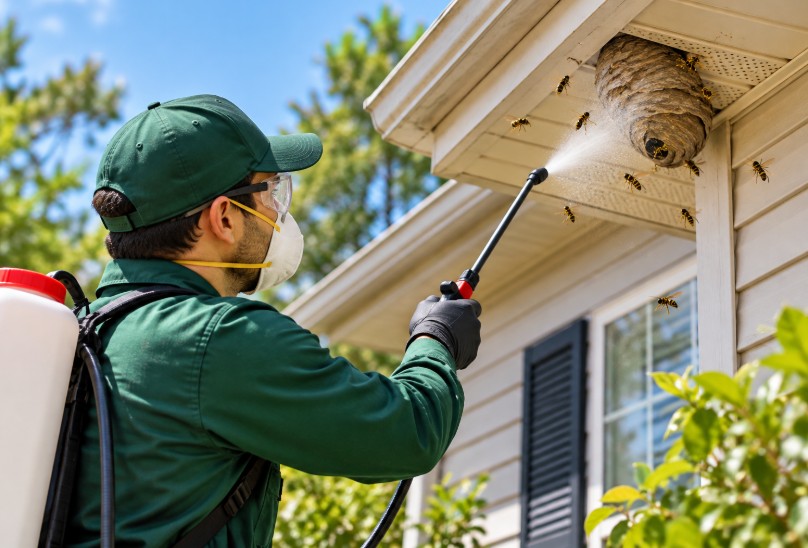
Wasp Nest Removal in Greensboro, NC — Nests Gone, Wasp Controlled
A wasp nest by the front door, yellow jackets pouring out of the lawn, a buzzing sound inside the bedroom wall. We identify exactly what's building the nest, remove it safely at the right time of day, and treat the spots wasps like to rebuild, so you can use your porch, deck and yard without watching every step.
Protective gear, proper products and a Greensboro team that handles stinging insects every season.
Why people call us instead of grabbing a can of spray:
We remove the whole colony, including the ones you don't see
Complete nest eradication and brood removal so queens and pupae cannot repopulate.
Ground and in-wall nests handled without driving wasps into your house
Targeted non-repellent transfer treatments and sealed voids protect your indoor living spaces.
Honey bees identified and referred to local beekeepers, not sprayed
Ethical pollinator preservation connecting with Guilford County beekeeper networks.
North Carolina licensed and fully insured
NC certified stinging insect applicators with complete property liability coverage.
Found a Nest? Do This Right Now
Back away calmly
Don't swat, run past the entrance or spray it with the hose. Sudden movement and vibration set off defensive wasps, especially yellow jackets.
Protect kids & pets
Keep kids and pets inside and away from that side of the house or yard until a professional inspects the area.
Stop yard work nearby
Don't mow, trim or blow leaves near a ground nest. Mower vibration is one of the most common ways people get stung here in late summer.
Do not plug the hole
If wasps are going in and out of a gap in siding, brick or a vent, sealing it can push them through the drywall and into your home.
Observe from distance
Note where the nest is and what the insects look like from a safe distance. A photo taken from far away helps our technicians prepare before arrival.
Then contact us. A licensed technician can be at your door within 60 minutes.
Anywhere in Greensboro, our team arrives equipped with proper protective suits and specialized materials to identify the nest and plan safe removal.
What's Building That Nest? Identify It by What You See
The fastest way to identify a stinging insect is often the nest structure itself.
Paper Wasp
Look under eaves, porch ceilings, window frames, deck railings, shutters, grill lids and playset roofs. NC State Extension notes these nests usually reach 6 to 8 inches across with a few dozen wasps. They'll sting to defend the nest but rarely chase.
Eastern Yellow Jackets
NC State Extension notes the eastern yellow jacket is the most abundant yellow jacket in North Carolina, with colonies reaching anywhere from several hundred to around 3,000 workers by late summer. They defend aggressively and can sting repeatedly.
Bald-Faced Hornet
Despite the name, bald-faced hornets are actually a type of yellow jacket. They're black and white, very defensive, and their nests can grow larger than a basketball by late summer.
European Hornet
The biggest wasp in the Triad. Workers reach ~1 inch long, nest in hollow trees and wall voids, and unlike most wasps they are active at night and buzz around porch lights. They also strip bark from lilacs and ornamental shrubs.
Mud Daubers
Mud daubers are solitary wasps that rarely sting and actually hunt nuisance spiders. We can scrape and clean the mud nests, but they pose virtually zero threat to your family.
Carpenter Bees
Carpenter bees, not wasps. Males hover aggressively around faces but have no stinger; females rarely sting. However, they bore gallery tunnels that cause structural wood damage over time.
Cicada Killers
Huge wasps flying low over lawns. While intimidating in size, they are harmless to humans. Males lack stingers and females only hunt cicadas. NC State Extension considers them beneficial.
Honey Bee Swarm
Do not spray honey bees. Swarms are simply looking for a new hive home. We identify honey bees and coordinate safe relocations with local Guilford County beekeepers.
Where the Nest Is Changes How We Remove It
Different nesting locations require specialized tools, timings, and non-repellent barrier formulations.
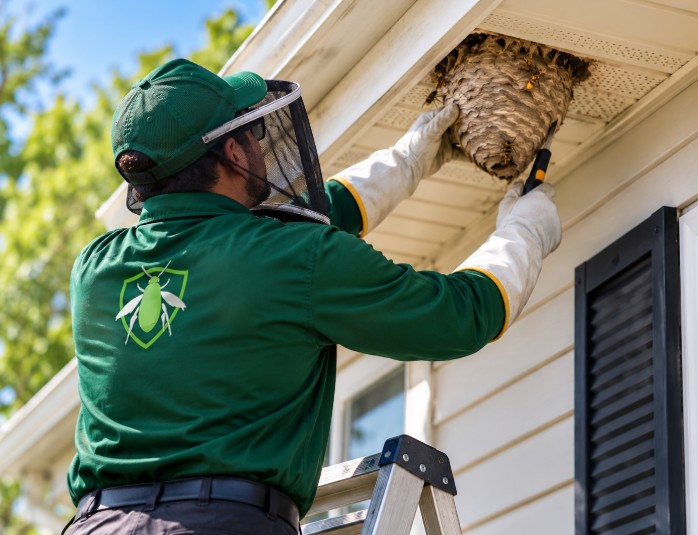
Precision Removal for Every Nesting Habitat
Whether elevated 20 feet under an overhang, concealed within brick weep holes, or buried in Piedmont clay burrows, our technicians follow strict NC State Extension protocols to eliminate the active queen and brood without driving stinging insects indoors.
Under eaves, porch ceilings and overhangs
The most common place homeowners find nests. They are usually easy to reach, but they're often right over a door or walkway. We treat the nest, wait for the colony to die, then remove the paper and treat the surrounding eave to discourage rebuilding.
Deck rails, playsets, mailboxes, grills and outdoor furniture
Small paper wasp nests hide in these spots all summer. We check the undersides and inside hollow rails, because where there's one nest there are often a few more nearby.
In the ground
Yellow jacket nests hide under landscape timbers, in old rodent burrows, around tree roots, under shrubs and in bare clay banks. We treat the entrance with a dust at dusk or night when the colony is home, so returning workers carry it inside. The nest is dead within a day or two.
Inside walls, soffits and brick weep holes
This is where DIY goes wrong most often. Yellow jackets and European hornets move into wall voids through siding gaps, soffit vents, utility openings and the small weep holes along the bottom of brick walls. We treat through the entry point without sealing it, confirm the colony is dead, and only then recommend closing the gap. Occasionally a large wall nest needs a small access opening to remove.
In the attic
Attic nests can go unnoticed until wasps start showing up indoors. We locate the nest from inside and out and treat it directly where it hangs.
In trees and shrubs
Bald-faced hornet nests in trees and hedges may be high up or buried in dense branches. We use specialized pole extension equipment to reach them safely rather than climbing ladders under active nests.
Inside the house, in winter
On warm winter days, Greensboro homeowners sometimes find slow, sleepy paper wasps inside. These are usually queens that tucked into the attic or wall voids in the fall to overwinter. A few are normal. Lots of them point to an exterior entry point we can help you find and seal.
How a Wasp Nest Removal Visit Works
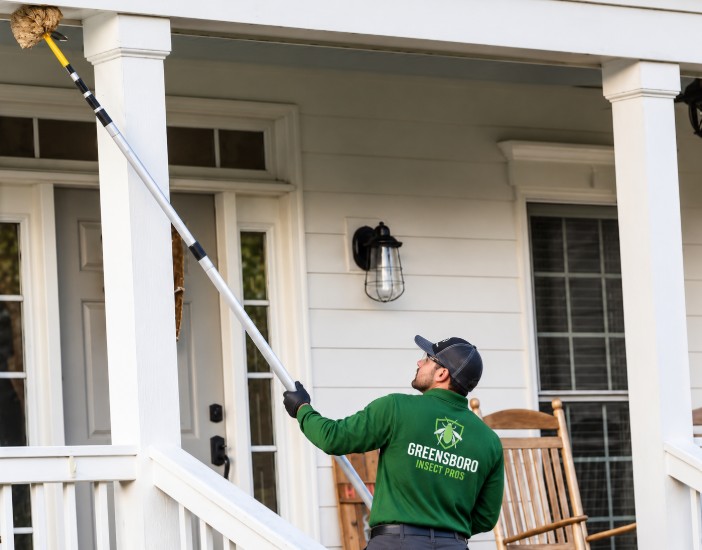
Calm, Methodical & Complete Eradication
From the moment we arrive at your property to the final rebuild prevention treatment, our process focuses on safety, colony eradication at the source, and protecting your living spaces.
Arrival
A licensed technician is at your door within 60 minutes of your call, anywhere in the city. We look at the nest from a safe distance, confirm the species and check for other nests nearby.
Timing
Open paper wasp nests can often be handled right away. For yellow jackets, hornets and wall or ground nests, the best time is usually dusk or after dark, when foragers are back inside and calmer. If a nest is causing an immediate hazard, we'll deal with it on the spot with the right gear.
Treatment
We use products labeled for stinging insects, chosen for the nest type: aerosols and foams for exposed nests, dusts that workers carry deep into ground and wall nests, and targeted treatment around entry points.
Removal
Once the colony is dead, we take down exposed nests and clean up the paper. Leaving an old nest in place can attract other insects that feed on the dead larvae.
Prevention
We treat eaves, overhangs and favorite rebuilding spots, point out entry gaps worth sealing, and let you know what to watch for.
Follow-up
If you see activity at the same nest after treatment, let us know and we'll come back to check it.
Why Late Summer Is When People Get Stung
Every stinging insect colony here starts from scratch each spring. Here's how a Greensboro yellow jacket nest typically plays out:
Lone Queen Emergence
A single queen that survived winter under bark, in a stump, woodpile or attic wakes up and starts a small nest, raising her first workers by herself. At this stage, nests are the size of a golf ball and easy to deal with.
Worker Population Surge
Workers take over building and foraging, and the colony grows quickly through our long, warm season. Most people still haven't noticed the nest.
Peak Aggression & Scarcity
The colony is at its largest. NC State Extension notes that yellow jacket queens and males are produced in late summer and early fall, and a healthy colony may produce hundreds of new queens. As natural food runs short, workers get more defensive and more interested in your sodas, trash cans, fallen fruit and cookout food. That's why August and September bring the most stings, especially from mowing over ground nests.
Colony Die-Off & Queens
Workers die off, usually after the average first frost around the end of October. Only newly mated queens survive, hiding in sheltered spots to start new nests next spring. Yellow jackets don't reuse old nests, but they'll happily build a new one in a similar spot.
Honey Bees Are Different
Honey bees are important pollinators, and many Guilford County residents keep hives. We don't exterminate honey bee swarms.
Swarm Relocation
A swarm is a cluster of bees hanging on a branch, fence or eave while scouts look for a new home. Swarms are usually calm and often move on within a day or two. The Guilford County Beekeepers association keeps a list of local members who collect swarms.
Structural Extractions
An established colony inside a wall or roof is a bigger job. Removing it properly usually means opening the wall to take out the comb and honey, because leftover honey can melt, stain and attract other pests. This takes a beekeeper, sometimes working with a contractor.
Not Sure If It's Bees or Wasps?
Honey bees are fuzzy and golden-brown, and they hang in clusters. Wasps and yellow jackets are smooth, shiny and brightly marked. Send us a photo or let our technician take a look, and we'll point you in the right direction either way.
Wasp Trouble Spots Around Greensboro Homes
Different architecture and landscaping throughout Greensboro create distinct stinging insect micro-habitats.
Historic In-Town Neighborhoods
Fisher Park, Westerwood, College Hill & Irving ParkWood siding, deep porches, detailed trim and gaps that have opened up over a century give paper wasps and yellow jackets plenty of places to build. Big hollow trees in these neighborhoods are also prime European hornet territory.
Brick Ranches
Starmount, Lindley Park & Hamilton LakesBrick weep holes and gaps around old vents and utility lines are common yellow jacket entry points into wall cavities. Mature landscaping and landscape timbers hide ground nests.
Newer Subdivisions
Lake Jeanette, Brassfield, Adams Farm & GrandoverVinyl soffits, gable vents, deck railings and play sets are favorite paper wasp spots. Fresh landscaping, mulch beds and wooded common areas give yellow jackets room for ground nests.
Wooded Lakeside Lots
Near the Lakes, Summerfield & Oak RidgeStumps, woodpiles, rodent burrows and hollow trees support large yellow jacket and European hornet colonies, and bald-faced hornets build high in the trees.
Businesses, Schools & Shared Spaces
Commercial Patios, Pool Decks, Playgrounds & AthleticsRestaurant patios, pool decks, playgrounds, ball fields, church grounds and trash corrals all draw foraging yellow jackets in late summer. We schedule treatments around customers, students and events.
Stung? What to Do
For most people, a wasp sting is painful but manageable with standard care:
- Move away from the nest area first. Wasps can keep stinging and release alarm pheromones that attract nestmates.
- Wash the sting with mild soap and clean water to prevent bacterial infection.
- Apply a cold pack for 10 to 20 minutes to reduce localized pain and tissue swelling.
- An antihistamine and a pain reliever (such as ibuprofen or acetaminophen) can help with itching and discomfort.
- Check for stingers: Honey bees leave a barbed stinger behind. Wasps and yellow jackets usually don't.
When to Call 911 (CDC Mortality Data)
Call 911 for trouble breathing, swelling of the face, lips or throat, dizziness, fainting, a weak or racing pulse, or multiple stings on a child or older adult. Stings are more serious than many people think. According to the CDC, 788 people in the United States died from hornet, wasp and bee stings between 2011 and 2021 (an average of 72 deaths a year, with 84% being male).