
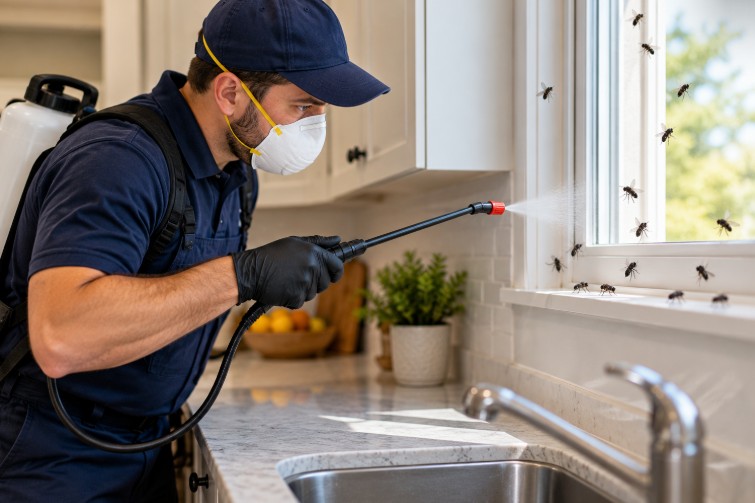
Fly Control in Greensboro, NC — We Track Flies Back to Where They Breed
A fly problem is really a source problem. Somewhere nearby there's a recycling cart, a drain, a houseplant, a dog run or a dead squirrel in the attic producing new flies every few days. Our Greensboro technicians identify the fly, follow it back to that source, remove it, and then deal with the adults and the gaps letting them indoors.
Fly control for Greensboro homes, restaurants and businesses, from our office at 200 N Greene St.
How We Solve the Problem:
-
01Name the fly.
The species tells us where to look.
-
02Remove the breeding source.
This is what ends the problem.
-
03Clear the adults and close the entry points.
So they don't come right back.
Why Swatting Never Works
Flies breed fast in a Greensboro summer. With July highs averaging near 89°F and humid nights, a house fly can go from egg to adult in a week to ten days. Kill twenty today, and twenty more hatch tomorrow from wherever they're breeding.
That's why a good fly exterminator spends more time looking than spraying. Every kind of fly needs something specific to breed in, and once that's gone, the adults you're seeing die off within days and nothing replaces them.
Match the Fly to the Source
The physical appearance and location of the fly indicate the precise breeding medium that must be corrected.
| Fly | What it looks like | Where you notice it | Usual source | What fixes it |
|---|---|---|---|---|
|
House fly
|
Gray, about ¼ inch, four dark stripes on the back | Kitchens, patios, garages, trash areas | Garbage, pet waste, compost, spoiled food | Sanitation, tight lids, baits, screens |
|
Blow fly / bottle fly
|
Metallic green, blue or bronze, loud buzz | Suddenly at windows, often dozens at once | A dead animal in a wall, attic or crawl space; garbage | Find and remove the carcass |
|
Fruit fly
|
Tiny, tan, red eyes | Fruit bowl, trash, recycling, bar areas | Fermenting produce, drink residue, sticky spills | Remove the food source, clean bins and drains |
|
Drain fly
|
Tiny, fuzzy, moth-like wings held flat | Bathroom and kitchen sinks, showers, floor drains | Slimy buildup inside drains | Scrub and enzyme-clean drains |
|
Phorid fly
|
Tiny, humped back, runs in short bursts | Drains, trash, slab floors | Clogged drains, garbage, broken sewer lines under slabs | Locate the source, sometimes with a plumber |
|
Fungus gnat
|
Tiny, dark, weak flier | Over houseplants and at windows | Soggy potting soil | Let soil dry, change watering |
|
Cluster fly
|
Larger than a house fly, slow, golden hairs on back | Sunny windows in fall and on warm winter days | Overwintering in attics and wall voids | Seal gaps before fall, vacuum |
|
Midge
|
Mosquito-like, doesn't bite | Swarming at porch lights near water | Lakes, ponds, stormwater basins | Change lighting, treat resting areas |
How Greensboro's Trash, Recycling and Yard Waste Schedule Feeds Flies
A lot of local fly problems start at the curb. Here's how the city's collection schedule plays into it.
Recycling goes out every other week
Trash is collected weekly in Greensboro, but recycling is picked up every other week. A recycling cart holding unrinsed soda cans, beer bottles, yogurt cups and pizza boxes can sit in summer heat for up to 14 days, which is long enough for more than one generation of fruit flies and house flies. Rinsing containers makes a bigger difference here than almost anything else.
The gray yard waste cart is for yard debris only
The city collects yard waste weekly in a gray 95-gallon cart. Grass clippings can go straight in, but wet clippings packed into a closed cart in July ferment quickly and draw flies if the cart sits open or cracked. The city doesn't allow animal waste in that cart.
Pet waste belongs in the trash, bagged
The City of Greensboro's stormwater program asks residents to bag pet waste and put it in the trash, and notes that a single gram contains around 20 million fecal coliform bacteria. Left in the yard, it's also one of the most productive house fly breeding sites there is. Picking up a couple of times a week breaks the cycle.
Trash carts need a rinse
The liquid that collects in the bottom of a cart is enough to raise maggots by itself. Bag food waste, keep lids shut and hose the cart out every few weeks during summer.
Dead animals at the curb
The City of Greensboro offers dead animal pickup from city streets. A carcass inside your wall, attic, crawl space or chimney is a different story, and that's where we come in.
“Suddenly There Are Dozens of Big, Shiny Flies at the Windows”
A sudden burst of metallic green or blue flies indoors almost always means something died where you can't see it.
NC State Extension explains that blow fly eggs hatch in about a day, the maggots feed for roughly a week, and new adults emerge about eight days after that. So a squirrel, mouse, rat or bird that died in a wall void, attic, chimney or crawl space a couple of weeks ago can suddenly fill a room with flies. It often happens after a rodent problem or rodent baiting, when poisoned animals die inside the structure.
Common Greensboro Structural Culprits:
- Gray squirrels: Attics of older, tree-shaded Piedmont homes
- Mice & rats: Under crawl-space houses and foundation cavities
- Birds & chimney swifts: Uncapped chimneys and roof eaves
What We Do:
Follow the flies and any odor to the most likely spot.
Check the attic, crawl space and wall voids thoroughly.
Remove the animal carcass source when it can be reached.
Clear remaining adults and locate the exact structural opening the animal entered through.
“Tiny Flies Around the Sink, Trash or Fruit Bowl”
Three small flies cause most of these complaints, and they need completely different fixes.
Fruit flies
These are the ones circling the bananas, the tomatoes you brought home from the Farmers Curb Market on Yanceyville Street, or the peaches ripening on the counter in July.
- Refrigerate ripe produce in summer
- Toss anything overripe immediately
- Rinse curbside & kitchen recycling containers
- Check for a forgotten potato or onion at the back of the pantry
Drain flies
Small, fuzzy and moth-like, resting on bathroom walls near sinks and tubs. They breed in the gelatinous film inside drains, especially in guest bathrooms and basement floor drains that don't get used much.
- Mechanically scrub the interior pipe surface
- Apply an enzymatic or bacterial drain cleaner that digests organic slime
- Run water periodically through seldom-used basement & guest traps
Phorid flies
Humpbacked little flies that scurry across counters in quick bursts instead of flying off when approached.
If they keep showing up in a spotless slab-built home, restaurant or commercial office, a hidden plumbing leak beneath the concrete is a real possibility.
The Tape Test
Virginia Tech Extension Protocol for Tracking DrainsBefore bed, lay a strip of clear packing tape, sticky side down, loosely across each drain opening. Flies stuck to the underside in the morning confirm exactly which drain is the breeding source, preventing unnecessary plumbing teardowns.
“Swarms at the Porch Light” — Midges Near Greensboro's Lakes
If you live near Lake Jeanette, one of the three city reservoirs (Brandt, Higgins and Townsend) or a neighborhood stormwater pond, you've probably seen clouds of small, mosquito-like insects gathering at lights on warm evenings. These are usually non-biting midges, sometimes called “blind mosquitoes.”
NC Cooperative Extension notes they breed in lakes, ponds, deep ditches and slow streams, start emerging in late March or early April, and can produce new generations every two to three weeks through fall. They're strongly drawn to outdoor lights and pile up on windows, siding and porch ceilings. They don't bite, but they're messy and they feed the spiders that follow them.
What Helps Most Around Greensboro Waterways:
Midges are attracted to blue and cool white spectrums; warm yellow LEDs reduce gathering by up to 80%.
Relocate pole lights or pathway lanterns into the yard to draw midges away from entry thresholds.
Prevents indoor illumination from turning lakeside windows into massive insect beacons.
Nitrogen and phosphorus runoff promotes heavy algae blooms, which directly feed developing midge larvae in ponds.
We can treat the exterior siding, soffits, window frames and porch ceilings where midges rest during the heat of the day, breaking the swarm and cutting off the spider food supply.
“Slow, Sleepy Flies on Sunny Windows in Winter”
Cluster flies (Pollenia rudis)
These are almost always cluster flies. They're a little larger than house flies, sluggish, and have fine golden hairs on the back.
On a mild January afternoon, they wake up and blunder into living spaces, usually ending up on a window. They don't breed indoors, and they have nothing to do with cleanliness.
The Fix & Crucial Warnings:
The real fix is sealing up before fall. Close gaps around windows, siding, soffits and utility lines in late summer before temperatures dip.
Indoors, simple vacuuming handles active adults without introducing chemicals to living rooms.
“Gnats Over My Houseplants”
Fungus Gnats in Potting Soil
Fungus gnats breed in potting soil that stays wet. University of Kentucky notes their life cycle runs about a month. Overwatering is the usual cause, especially in winter when plants drink less and the heat is on.
Let the top inch or two of potting soil dry completely between waterings to dehydrate gnat larvae.
Never let decorative planters sit in standing saucer drainage water for more than 15 minutes.
Replace old, decaying, soggy soil mixes with fresh, well-draining sterile indoor potting media.
Place yellow sticky cards at the soil line to monitor adult population levels and intercept breeding adults.
Biting Flies and Other Outdoor Flies
Not all outdoor flies breed in garbage cans. Different environments across Guilford County produce distinct biting and non-biting species.
Deer flies and horse flies
Deer flies and horse flies breed in wet ground along creeks, ponds and wetlands, so they're common along the greenways, around the watershed lakes and on wooded lots.
Stable flies
Stable flies bite around the ankles and build up near horse barns and wet hay, which matters for horse properties in Summerfield, Oak Ridge and other parts of northern Guilford County.
Crane flies (“Mosquito Hawks”)
Crane flies, the gangly “mosquito hawks” bouncing around porch lights in spring, look alarming to many homeowners because of their long legs and large wingspan.
Fly Problems Across Greensboro
Greensboro's varying architecture, commercial density, and mature tree canopies create very specific fly pressures in each district.
Downtown, Elm Street and Tate Street Restaurants
Dumpster pads, grease bins, floor drains, bar fruit and patio dining keep house flies, fruit flies, drain flies and phorid flies busy from spring to fall. Older commercial buildings with aging drain lines add to it.
Historic In-Town: Fisher Park, Westerwood, College Hill & Dunleath
Squirrels in attics, uncapped chimneys and crawl spaces lead to blow fly outbreaks. Older cast-iron and clay drain lines collect the buildup that drain flies love. In winter, cluster flies turn up in tall attics and sunny upstairs rooms.
Mid-Century: Starmount, Lindley Park & Hamilton Lakes
Crawl-space homes with mature trees see rodents and squirrels, and with them the occasional dead-animal fly problem. Little-used basement and laundry drains are common drain fly sources.
Subdivisions: Lake Jeanette, Brassfield, Adams Farm & Grandover
Slab foundations make phorid flies worth investigating when they appear. Stormwater ponds and lakes bring midges to porch lights, and attached garages with trash and recycling carts inside are a frequent house fly source.
Student Housing Near UNCG & NC A&T
Shared kitchens, overflowing recycling and trash that waits for pickup day keep fruit flies and house flies going. We work with property managers on building-wide fixes.
Summerfield, Oak Ridge and the Rural Edges
Horses, chickens, compost piles and larger lots mean more house flies and stable flies, plus biting flies near ponds and creeks.
Greensboro's Fly Calendar
Spring Awakenings
Midges begin emerging around lakes and ponds. Crane flies show up at porch lights. Fungus gnats peak indoors as people overwater winter houseplants.
Produce & Heat Ascent
House flies and blow flies build as temperatures climb. Fruit flies appear with the first local strawberries, peaches and tomatoes.
Midsummer Peak Season
Peak season. Heat shortens every fly's life cycle, trash and recycling carts ripen fast, and patio dining draws flies to restaurants.
Late Harvest & Influx
Fruit flies stay heavy through tomato and apple season. Cluster flies gather on sunny walls and move into attics. A good time to seal gaps.
Indoor Microclimates
Outdoor flies fade, but drain flies, phorid flies and fungus gnats carry on indoors. Cluster flies wake up on warm days. Blow flies can still appear whenever an animal dies inside the house.
After the Power Goes Out
Summer thunderstorms, the remnants of tropical systems and winter ice storms all knock out power in the Triad from time to time.
Empty the fridge and freezer promptly, double-bag what you throw out, keep the lid on the trash cart, and wipe down the inside of the appliance. If flies follow anyway, call us.
What Happens on a Fly Control Visit
Here is our systematic forensic process when a Greensboro Insect Pros technician arrives at your property:
We get there quickly
A technician heads your way as soon as you call, with a one-hour arrival target for addresses in Greensboro.
We identify the fly
Everything else depends on getting this right. Different species require totally different remediation strategies.
We hunt for the source
Depending on the fly, that means drains, trash and recycling carts, under appliances, pet areas, compost, houseplants, the attic, the crawl space, wall voids or the dumpster pad.
We remove or treat it
We clean and treat the breeding sites we can reach. When the fix belongs to someone else, such as a plumber for a broken sewer line or a wildlife company for a live animal in the attic, we say so plainly.
We deal with the adults
Bait stations outdoors, targeted treatment of the sunny walls, fences and eaves where flies rest, sticky traps indoors, and insect light traps in commercial kitchens where they're appropriate.
We help keep them out
Torn screens, gaps around doors, open vents and uncapped chimneys all get pointed out, with practical fixes.
We follow up
Stubborn problems get a return visit to check traps and confirm the source is completely gone.
Restaurants, Bars and Food Businesses
One fly on a plate can cost a restaurant a customer. Several can cost points at inspection.
Guilford County Environmental Health inspects food establishments here, working from state rules modeled on the FDA Food Code. A few of those rules matter a lot for flies:
Insect light traps must hold the insects they catch and cannot be installed over food preparation areas.
Outside openings need protection, such as tight-fitting self-closing doors, screens or operational air curtains.
The premises must be checked routinely for pests, and conditions that harbor them have to be eliminated.
Our Commercial Fly Management Program Includes:
- Compliant placement and monthly bulb/glue-board servicing of Insect Light Traps (ILTs)
- Bioremediation and enzyme floor drain cleaning programs
- High-pressure dumpster pad, compactor and grease bin perimeter treatment
- Physical audit of exterior doors, weatherstripping and high-velocity air curtains
- Detailed written digital service records for your health inspection files
What Affects the Cost of Fly Control
Fly remediation is not a generic spray. Every service depends on the biology of the species and the physical accessibility of the breeding source.
Fly Species & Source Difficulty
The type of fly and how hard its source is to find, from a visible fruit bowl to a cryptic sub-slab plumbing crack.
Breeding Location & Physical Access
Where the source is located, such as an open sink drain, interior wall void, high attic rafter or deep beneath a concrete slab.
Property Size & Layout
Size of the home or commercial business, including the number of bathrooms, floor drains, prep areas and waste collection zones.
Carcass Removal & Pipe Cleaning
Dead animal extraction from attics/chimneys or mechanical drain foam/enzyme cleaning required as part of the initial visit.
Commercial Equipment & Service
Commercial equipment installation, such as Insect Light Traps (ILTs), air curtains, dumpster perimeter barriers, and scheduled servicing.
Service Frequency
Whether the situation requires a targeted one-time diagnostic treatment or an ongoing preventative program through the hot Piedmont fly season.
Why Flies Are More Than an Annoyance
Flies move from garbage, pet waste and rotting material straight to food and kitchen counters.
Roughly one-third of the bacteria found on blow flies can cause illness in people, and they mechanically carry dangerous pathogenic organisms such as E. coli and Salmonella. House flies spread germs the exact same way.
That matters most in homes with young children, older adults or anyone with a weakened immune system, and in any commercial business that prepares or serves food to the public.
Store-Bought Fixes: What Helps and What Doesn't
Retail shelves are full of quick-fix fly remedies. Here is an honest breakdown of which tools actually assist and which do more harm than good:
Aerosol Fly Spray
Knocks down a few visible adults in the room but does absolutely nothing to stop the source. NC State Extension notes sticky fly strips often work far better indoors without dispersing aerosol chemicals.
DDVP Pest Strips
Should never be used in occupied living rooms, kitchens or bedrooms, especially around young children or people with respiratory conditions, according to NC State Extension.
Vinegar & Dish Soap Traps
Catch fruit flies and tell you where populations are thickest, but they cannot keep up with breeding rates and will not end an active kitchen infestation.
Bleach Down the Drain
Bleach runs right past the thick organic gelatinous slime layer without breaking it down. Drain fly larvae safely feed inside the biofilm untouched.
Smelly Outdoor Bag Traps
They work exceptionally well at catching flies, but they use putrid attractants that pull flies across the neighborhood toward your patio. Hang them far away on property lines, not beside the grill.
Electric Bug Zappers
Electrocuting bug zappers kill mostly harmless, beneficial nocturnal insects and attract clouds of midges directly toward your outdoor sitting areas.
Keeping Flies Down at Home
Kitchen
- Refrigerate ripe fruit and tomatoes in summer
- Wipe up juice, soda and grease, including under the stove and fridge
- Clean the garbage disposal and sink drains weekly
- Run water in guest bathroom and basement drains every week or two
Carts and Bins
- Rinse cans, bottles and containers before they go in the recycling cart
- Bag food waste and keep every lid tightly closed
- Hose out trash, recycling and yard waste carts through the summer
- Park carts in the shade, away from exterior doors and windows
Yard and Pets
- Bag pet waste and put it in the trash at least twice a week
- Cover or turn compost, and leave meat and dairy out of it
- Don't leave wet grass clippings sitting in an open cart or pile
House
- Fix torn window screens and install tight door sweeps
- Cap the chimney and screen attic and crawl space vents
- Seal gaps around windows, siding and utility lines before fall
- After a power outage, clear spoiled refrigerator food quickly
Licensed, Insured and Based Downtown
Treating flies in and around buildings counts as household pest work under North Carolina's structural pest control law. Our technicians hold the state credentials that work requires, use products labeled for flies, and are covered by our liability insurance on every job.
We work out of 200 N Greene St, a short walk from the Elm Street restaurant district, and we serve homes and businesses throughout Greensboro.