
Yellow Jacket Control in Greensboro, NC — Safe Removal for Ground and Wall Nests
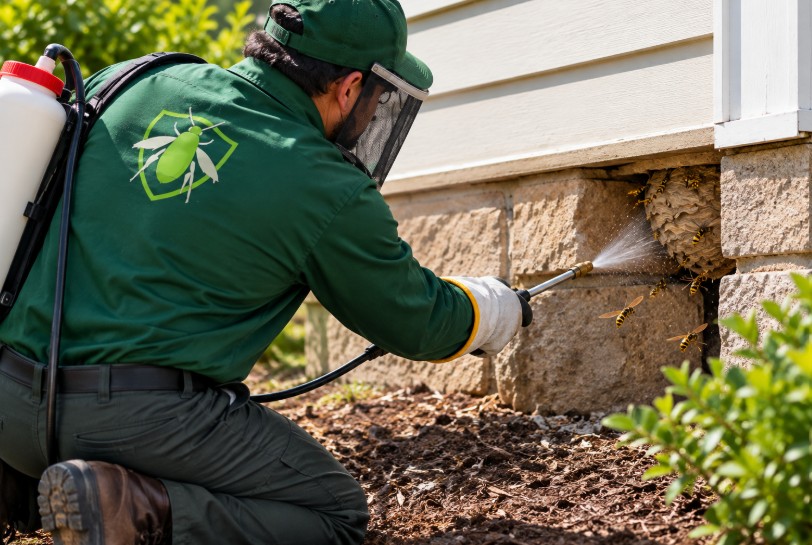
Yellow jackets don't give much warning. One pass with the mower or one step near a hidden hole, and dozens come boiling out. Greensboro Insect Pros finds the nest, treats it when the colony is home and calm, and makes sure it's dead before anything gets sealed, so the problem ends in your yard instead of inside your walls.
Handled by a licensed local team based in downtown Greensboro.
Why Greensboro Homeowners Trust Our Yellow Jacket Protocols:
-
Locates the actual nest, not just surface foragers
We track entry pathways deep into ground burrows, brick voids and landscape timbers. -
Dusk and after-dark treatment when the whole colony is inside
Targeting the colony when foragers return ensures complete elimination without daytime aggression. -
No sealing entry holes until the colony is confirmed dead
Prevents trapping live wasps inside wall voids where they chew through drywall into living spaces. -
Straight answers when a nest can simply be left to die out
Honest evaluations for late-season nests away from walkways that will naturally expire at first frost.
The Mower Moment
How Yard Work Turns Dangerous in Seconds
A lot of yellow jacket run-ins in Greensboro start the same way. It's a warm afternoon in late August. You're cutting the grass along the flower bed, or edging near the old landscape timbers by the driveway, and suddenly there's a cloud of angry yellow jackets around your legs. You didn't see a nest because there wasn't anything to see, just a small hole in the ground with a few insects coming and going.
That hidden hole can hold thousands of stinging insects by the end of summer. The vibration of a mower, a string trimmer or even footsteps is enough to set them off.
If That's Where You Are Right Now:
- ✓ Step away calmly: Do not swing, swat, or run through the flight path.
- ✓ Get inside: Keep children, pets, and neighbors completely away from that part of the yard.
- ✓ Stop all lawn equipment: Leave the mower where it is; vibration keeps them in defense frenzy.
Then contact us. We'll have a licensed technician at your door within 60 minutes, wherever you are in Greensboro, to locate the nest and plan how to safely remove it.
The Yellow Jackets We Deal With in Greensboro
"Yellow jacket" covers a few closely related wasps around here. They look similar, but where they nest changes the removal strategy completely.
Eastern Yellow Jacket
The most common yellow jacket in North Carolina, according to NC State Extension, and the one behind most ground nests in local yards. Colonies nest underground, usually in an existing cavity such as an old rodent burrow, a gap under a landscape timber or the rotted roots of a stump. NC State notes an eastern colony left undisturbed can grow to roughly 3,000 workers.
Southern Yellow Jacket
A slightly larger, more orange-tinged relative that also nests underground. Its queens often take over eastern yellow jacket nests rather than building their own. NC State Extension notes that in some years up to 40% of eastern yellow jacket nests are taken over this way, mainly by southern yellow jackets, producing volatile, defensive colonies.
Bald-Faced Hornet
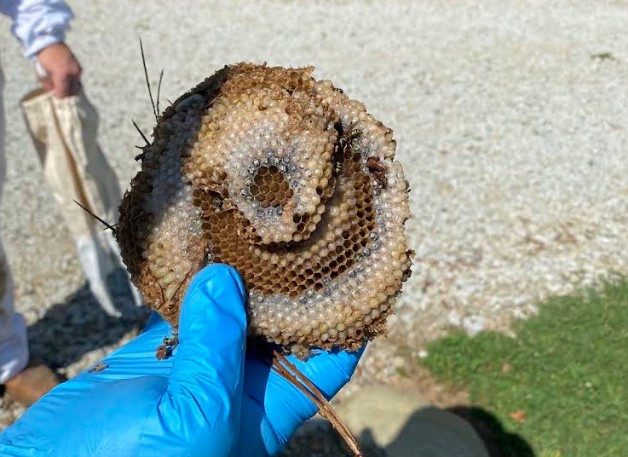
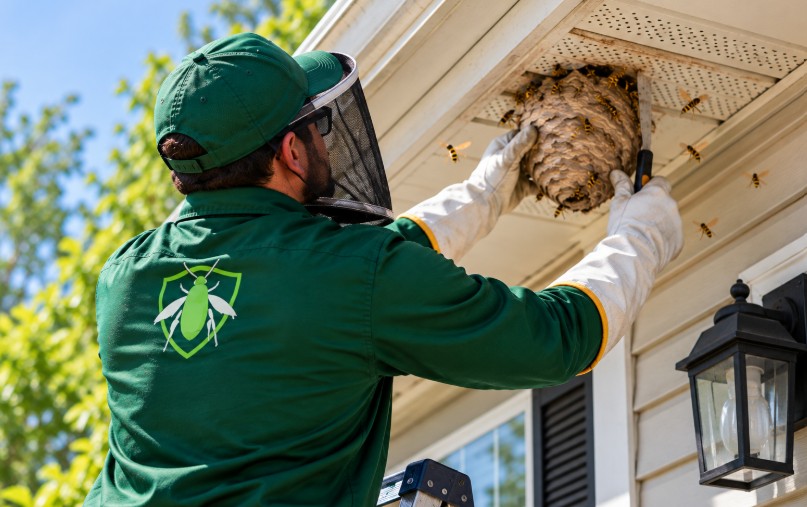
Black and white instead of black and yellow, but still a yellow jacket by family. It builds gray, football-shaped paper nests in trees, shrubs and under roof eaves. Despite nesting above ground, it is every bit as defensive and will vigorously protect aerial nests if vibrations reach branches or rafters.
Yellow Jackets in Structures
When ground-nesting species find a gap into a wall, crawl space, attic or the hollow space behind brick weep holes, they'll build inside the house instead. These are the nests that most often turn into indoor emergencies, as trapped wasps can chew through drywall directly into bedrooms and living spaces.
Is it really a yellow jacket?
A quick way to tell them apart from common Greensboro look-alikes:
Yellow Jackets
Smooth and shiny with sharp yellow-and-black bands, about the size of a honey bee, and fly fast and low in and out of a single entrance hole.
Honey Bees
Look hairy, fuzzy, and amber-to-brown colored. They almost never build in the ground. (We connect homeowners with local beekeepers for swarm relocation).
Paper Wasps
Longer and thinner with dangling legs during flight. They build open, exposed umbrella-shaped honeycomb paper nests you can easily see under eaves.
Cicada Killers
Much bigger (up to 2 inches long), solitary ground-nesters active in early-to-mid summer with dirt mounds. Rarely a stinging threat to humans.
Local Greensboro Terminology: Many Greensboro homeowners call yellow jackets "ground bees." If you're unsure which insect you have, our technician will identify it on the spot before treatment. For paper wasps, bald-faced hornets and other stinging insects, see our wasp nest removal page.
Finding the Nest: Watch the Flight Line
Listen indoors
A nest inside a wall or ceiling often makes a faint crackling or humming sound, and you may see yellow jackets on the inside of windows or buzzing around light fixtures. If you hear this, do not press or probe the drywall!
The hardest part of yellow jacket removal is often finding the nest. Here's how we do it, and how you can help without getting stung:
Look for traffic
On a sunny afternoon, stand at least 20 feet away and watch. Yellow jackets fly in and out of a nest entrance in a steady stream, low to the ground, like planes at a busy airport. Follow the line with your eyes rather than your feet.
Mark it from a distance
Once you spot the hole, note a landmark nearby, such as a shrub, a fence post or a garden stake. Don't walk up to it or stick anything in the hole.
Check the usual Greensboro hiding spots:
Our Yellow Jacket Removal Process
A systematic, biology-first approach designed to eliminate ground burrows and structural wall colonies without driving defensive swarms into your home.
NC State Extension Ground Nest Guideline
"NC State Extension recommends treating yellow jacket nests near dusk or after dark, when foraging workers are inside and colony defensive flight is minimal. Bright white lights must never be shone directly at entrance holes."
Scouting during the day
When we arrive, we confirm the species, find the entrance and check for additional nests nearby, since a yard with one nest sometimes has more than one. We also look at the path from the nest to your doors, patio and play areas.
Treating at dusk or after dark
NC State Extension recommends treating yellow jacket nests near dusk, when the wasps are inside. We follow that approach for ground and wall nests. We work without bright white light at the nest, since light draws yellow jackets straight toward whoever is holding it.
Using dust where it counts
For ground and wall nests, we apply an insecticidal dust at the entrance. Returning workers walk through it and carry it deep into the nest, reaching the queen and brood where a spray can't. For aerial nests like bald-faced hornets, we treat and then remove the whole nest.
Checking the next day
Most colonies are dead within a day or two. We check activity and retreat if needed. A few returning foragers hovering around the entrance for a day or so is normal.
Handling wall nests carefully
We never seal a wall entrance until the colony is confirmed dead. If yellow jackets are already chewing into the living space or the nest is large, we may recommend a small access opening to remove it.
Cleaning up and sealing
Once the nest is dead, we remove exposed nest material, recommend how to close up the entry point, and point out other gaps where next year's queens might move in.
Why Yellow Jackets Get Meaner in August
It isn't your imagination. Yellow jackets really do change as summer goes on, and it's tied to what they eat.
Early summer: hunters
The colony is busy raising larvae, and larvae need protein. Workers hunt caterpillars, flies and other insects, which is why yellow jackets are actually helpful garden predators for part of the year. They trade the protein to larvae for a sugary liquid the larvae give back.
Late summer: sugar seekers
By August and September, the colony is at its biggest and is producing new queens and males. The number of larvae drops, and so does the sugar supply that came with them. Hungry adult workers start hunting sugar on their own, and they find it in soda cans, sweet tea, ripe muscadines and figs, fallen apples and pears, hummingbird feeders and trash cans.
Could Greensboro Get a Yellow Jacket "Super Nest"?
In the Deep South, mild winters occasionally let yellow jacket colonies survive into a second year instead of dying off. Alabama has documented these "super nests" after mild winters, with some reported at three to four times normal size and around 15,000 workers, and a South Carolina nest was reported with roughly 250,000 workers.
These are rare, and they're reported mainly farther south. But our winters in the Piedmont are mild too. If you see a yellow jacket nest that's still active in winter, or one that's unusually massive, stay well away and call a professional.
Yellow Jacket Traps: What Works Here and What Doesn't
Traps are one of the most common things homeowners try, so here's the honest picture for North Carolina based on USDA and university entomology research.
Western vs. Eastern Lures
Many store-bought traps are built for western species. The USDA's Agricultural Research Service reports that heptyl butyrate, a common yellow jacket lure, works for the western yellowjacket but is ineffective for yellow jacket species in the eastern United States. If you've hung a trap and caught very few, that may be why.
Traps Don't Eliminate Colonies
Traps don't eliminate a colony. Even when they catch plenty of workers, the queen keeps producing more. School IPM guidance from Texas A&M notes traps aren't effective for eliminating entire colonies, as adult forager loss does not stop reproduction in the brood nest.
Seasonal Bait Requirements
Bait choice changes with the season. Protein baits (such as meat or canned fish) work better earlier in summer when workers feed developing larvae. Sweet baits (sugar syrups or fruit) work better in late summer and fall when workers forage for carbohydrate energy.
Placement Strategy
Placement matters tremendously. Traps draw yellow jackets in with attractants, so hang them along property perimeters away from patios, doors and play areas, never right next to where family, guests or pets sit.
Key Takeaway for Homeowners: Traps can help reduce foragers at an outdoor cookout or event, but they cannot replace treating and eliminating the subterranean or structural nest itself.