Spider Control Service in Greensboro, NC
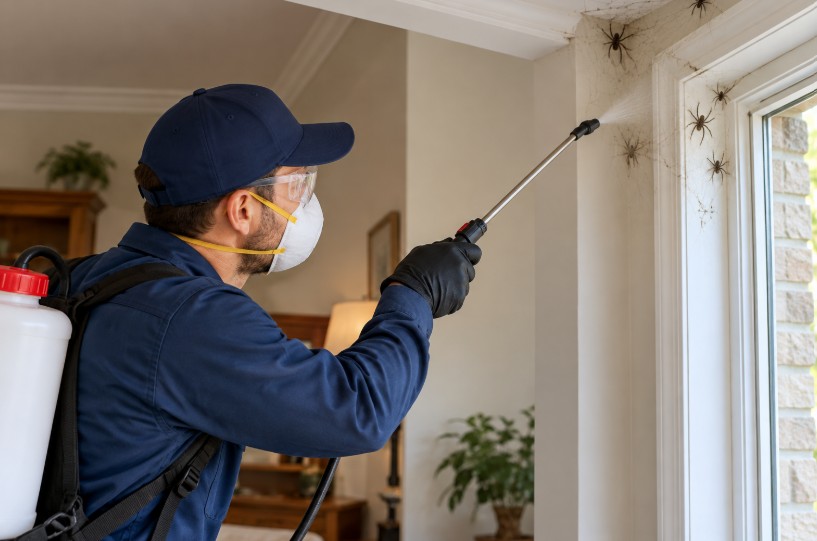
A few spiders in the garden are a good thing. Webs strung across every porch light, black widows by the crawl space door and wolf spiders running across the living room floor are not. Our spider control service clears what you can see, treats where spiders hide, and goes after the insects that keep drawing them to your house.
From a local team at 200 N Greene St that knows Greensboro's porches, crawl spaces and lake lots.
What Our Spider Service Covers:
-
Web and egg sac removal from eaves, soffits, porch ceilings and entryways
-
Treatment of cracks, gaps and hiding spots inside and out
-
A check of lights, landscaping and entry points that attract spiders
-
Honest identification, including when a spider is harmless
A Quick Reality Check About Spiders
North Carolina is home to roughly 700 kinds of spiders, according to NC State Extension, and almost all of them are completely harmless to people. Outdoors, they're some of the best free pest control you'll get, eating flies, mosquitoes, moths and destructive garden pests.
So our goal isn't to wipe out every spider on your property. It's to keep them out of your living space, get the unsightly webs off your house, deal firmly with the few species that can hurt you, and make your home far less attractive to spiders in the first place.
Which Spider Did You Find?
The fastest way to narrow down what you are dealing with is where you found it on your property:
On the porch, eaves & around outdoor lights
Mostly orb weavers: the big, round, wheel-shaped webs that appear overnight across doorways, between shrubs and under porch lights. Late summer and fall bring the biggest ones, including the black-and-yellow garden spider, which NC State Extension notes is a common fall orb weaver.
In the garage, shed, woodpile or crawl space
This is where widow spiders like to set up, along with cellar spidersโthe long-legged, thin spiders with messy, tangled webs. Widows deserve immediate caution.
Running across the floor
Large, fast, brown or gray spiders that don't sit in webs are usually wolf spiders. NC State Extension notes they're among the spiders that most often wander into homes. They hunt actively at night, look intimidating, and are rarely a real threat.
In ceiling corners, window frames & behind furniture
Common house spiders and cellar spiders ("daddy long-legs"). They build small tangled cobwebs in stagnant corners and signal that there are enough smaller insects inside your home to feed their population.
On windows, exterior siding and fences
Jumping spiders: small, compact, fuzzy, bold and remarkably curious. They do not build webs to capture prey; instead, they stalk flies and gnats using excellent eyesight.
In low shrubs, ivy and thick ground cover
Flat, dense sheet-like horizontal webs with a narrow retreat funnel at one end belong to funnel web (grass) spiders. They are especially prevalent across foundation plantings and thick mulch from late summer into late autumn.
On docks, boathouses and lake-lot basements
Very large, banded brown spiders living near water are usually fishing spiders (Dolomedes). Penn State Extension notes they are shy, tend to run rapidly from people, and their rare bites are usually comparable to a mild bee sting. Homes near Lake Jeanette, Lake Brandt, Lake Townsend and city creeks frequently spot them basking on boat docks, lakefront decks and walk-out basements.
Widow Spiders: The Group to Take Seriously
NC State University lists three widow species documented in North Carolina:
Southern Black Widow
The primary widow in Guilford County. Usually establishes its irregular, high-tensile tangled web close to the ground in dark, undisturbed pockets.
Northern Black Widow
Similar potent venom, but tends to set up its web slightly higher off the ground, such as in shrubs, woodpiles, and tree cavities.
Brown Widow
A newer arrival to the state and still uncommon. NC State Extension notes brown widows are less aggressive and inject less venom than black widows.
What to look for:
Adult female black widows are shiny coal-black with a globose body about half an inch long (over an inch including legs) and a distinct red marking on the underside of the abdomen, traditionally an hourglass.
NC State points out that markings can vary: some widows show broken dots, triangles or red dashes down the back, occasionally bordered in yellow or white. Young juvenile widows and adult males are noticeably smaller, often striped with lighter tan, orange and white markings.
Where they hide around Greensboro homes:
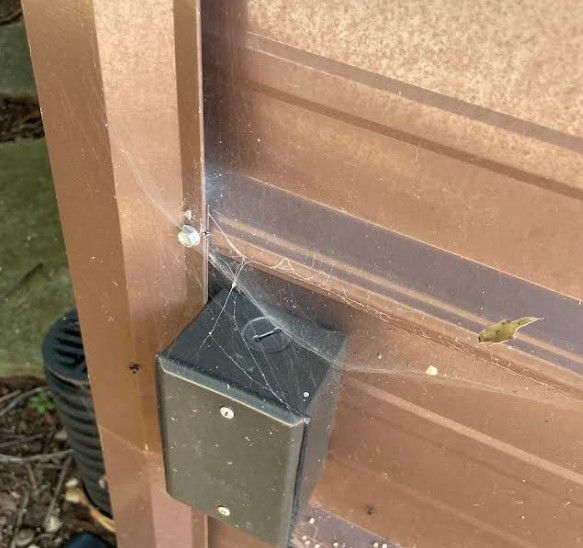
- โ Crawl space access doors, foundation vents & perimeter skirting
- โ Water meter pits, electrical boxes & irrigation control enclosures
- โ Stacked firewood, landscape timbers & leftover brick piles
- โ Undisturbed back corners of detached garages, tool sheds & carports
- โ Under outdoor patio furniture, barbecue grills & children's play sets
- โ Around exterior security lights that constantly attract night flying insects
About Bites & Medical Guidance
NC State notes that a black widow bite is rarely lethal to healthy adults, but the neurotoxic venom directly affects the nervous system, potentially causing intense local pain, profuse sweating, nausea, dizziness and severe abdominal muscle cramps.
NC State Extension advises applying ice and seeking prompt medical attention for any suspected black widow bite, and getting emergency help right away if the person bitten is a child, pregnant, elderly or in poor health. If you can safely capture the spider in a jar without risking another bite, bring it along to the clinic for definite identification.
When we find widows on your property, we treat their harborage points with residual targeted products, manually remove all dangerous webs and silken egg sacs, and show you exactly where to wear protective work gloves and what clutter to clear so future females don't move back in.
What About Brown Recluses?
The brown recluse is the spider people in North Carolina worry about mostโand usually without cause.
NC State Extension says plainly: Brown recluse spiders can technically be found in North Carolina, but they are "simply not very common." Several widespread, entirely harmless native brown spiders (such as wolf spiders, funnel weavers and cellar spiders) look similar enough to cause unnecessary panic and frequent misdiagnoses.
A few scientific clues that help tell them apart:
The Eyes (3 Pairs)
True brown recluses have six eyes arranged in three distinct pairs (dyads) with a space in between. Almost all other North Carolina spiders have eight eyes arranged in two rows of four.
The "Violin" Is Not Reliable
The dark violin-shaped marking behind the head is not reliable on its own. Cellar spiders, pirata wolf spiders, and southern house spiders often have dark cephalothorax marks that look like violins to the untrained eye.
Uniform Color on Legs
True recluses have uniformly colored, unbanded legs with no spines. If the spider has dark rings, stripes, spots or stiff bristly hairs on its legs, it is not a brown recluse.
Don't Guess โ Get Professional Verification
If you think you've seen a brown recluse in your Greensboro home, don't guess. Our licensed technicians will examine the specimen under magnification. If there is any doubt or suspicion, we'll place specialized sticky insect monitors in dark closets, storage rooms and along baseboards to capture and identify what is actually living in your structure before prescribing any unnecessary chemical treatments.
You can also submit physical specimens directly to the Guilford County Cooperative Extension Center (on Burlington Rd in Greensboro) or NC State University's Plant Disease and Insect Clinic for university confirmation.
Was That Really a Spider Bite?
Many unexplained skin lesions and painful sores get mistakenly blamed on spiders that never bit anyone.
In a major emergency department clinical study of 182 patients who presented believing they had a spider bite, 86% were diagnosed with soft tissue bacterial infectionsโmost commonly staphylococcus bacteria such as MRSA.
Fewer than 4% of patients had a medically verifiable spider bite. Spiders only bite in self-defense when directly pinched or crushed against the skin.
NC State Extension Medical Guidance
NC State Extension emphasizes the same clinical finding: secondary bacterial infections and ingrown hairs can create necrotic or ulcerating wounds that closely mimic the popular perception of a recluse bite.
For free, confidential medical questions regarding suspected insect bites or stings in North Carolina, contact the official Poison Control Center at 1-800-222-1222.
Joro Spiders: Are They Coming to Greensboro?
You may have seen sensational headlines about Joro spiders (Trichonephila clavata), the large black, yellow and blue-gray orb weavers native to East Asia that have established populations across Georgia and the Carolinas. Here is the objective science:
Arrival in North Carolina
First detected near Atlanta in the mid-2010s, Joro spiders systematically expanded northward, reaching western North Carolina mountain counties by the fall of 2021.
"Ballooning" Travel Mechanics
Spiderlings travel surprising distances by releasing gossamer silk threads to catch wind currents ("ballooning"), while adults frequently hitch rides on freight trucks and personal vehicles.
Zero Threat to Humans
NC State Extension affirms that despite their intimidating palm-sized leg span, they pose no dangerous threat to people or pets. Their bite, if provoked, is comparable to a mild bee sting.
Arrival: "When, Not If"
While most confirmed NC sightings have been centered in the western foothills, Triad entomologists and local university researchers consider their urban arrival in Greensboro a matter of when, not if.
Tracking via the iNaturalist App
NC State Extension requests North Carolina homeowners to photograph and report suspected Joro sightings through the public iNaturalist app to assist state entomologists in mapping migration corridors.
Why You're Seeing More Spiders
Spiders go where the food is. If you're noticing an explosion of webs and spiders, you almost always have an abundant supply of smaller prey insectsโeven if they escape your notice.
Key Factors Accelerating Greensboro Spider Activity:
Throughout the Piedmont Triad, specific architectural, environmental, and seasonal conditions turn residential properties into insect magnets. Addressing spiders effectively requires addressing these underlying moisture, lighting, and landscape attractants:
Porch & Landscape Lights
Bright white and bluish exterior bulbs draw clouds of moths, midges, and gnats every night. Spiders build webs directly across light fixtures, coach lanterns beside garage doors, and two-story front entryways to harvest easy prey.
Humidity & Crawl Space Moisture
North Carolina's sweltering summer humidity and unsealed, damp crawl spaces support massive populations of silverfish, crickets, and beetles. Long-legged cellar spiders and house spiders thrive in these dark, humid crawl spaces.
Proximity to City Lakes & Streams
Neighborhoods adjacent to Lake Jeanette, Lake Brandt, Lake Higgins, retention ponds, and neighborhood creeks experience constant aquatic midge hatches, fueling heavy spider populations on decks, docks, and eaves.
Shrubs & Trees Touching the House
Overgrown foundation boxwoods, crepe myrtle branches, and climbing ivy create direct physical bridges allowing spiders to migrate off mulch beds onto window screens, brick weep holes, and roof soffits.
Clutter, Yard Debris & Storage
Stacked cardboard boxes in carports, stored patio cushions, firewood piles stacked against exterior walls, and unused equipment give widows, wolf spiders, and sac spiders quiet, undisturbed nesting harborage.
The Late Summer & Fall Surge
Late summer and early autumn represent peak spider maturity. Female orb weavers reach their maximum physical size, while sexually mature male spiders wander actively in search of mates, causing sudden indoor sightings in September and October.
What Happens on a Spider Service Visit
A systematic, exterior-to-interior protocol designed to eliminate existing spiders, strip away web clusters and egg sacs, and target the underlying insect population feeding them.
Thorough, Methodical & Built for Piedmont Homes
We don't just spray baseboards and leave. Spider control requires high-reach web de-nesting, pinpoint barrier treatments at entry voids, and an entomological inspection to identify what insects are fueling the population.
We show up fast.
Our 60-minute response means a licensed technician is typically on your porch within an hour of the call, citywide.
We look before we treat.
We walk the outside of the home, check eaves, soffits, porch ceilings, window frames, lights, foundation plantings, crawl space openings, garages and outbuildings, and then check inside where you've seen activity. We identify the spiders and note what's feeding them.
We clear webs and egg sacs.
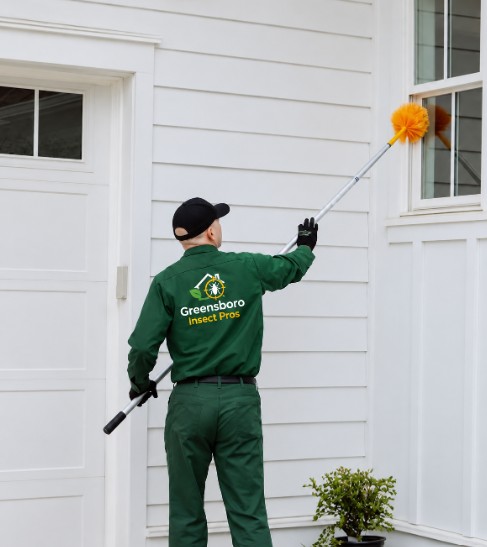
Using extension poles, we sweep webs and egg sacs from eaves, soffits, gutters, porch ceilings, window corners and entryways, including hard-to-reach spots on two-story homes. Removing egg sacs matters, since each one can hold many future spiders.
We treat hiding spots, not your whole house.
Outside, we treat the foundation, entry points, eaves, crawl space vents and other harborage. Inside, we treat cracks, gaps and undisturbed areas such as closets, garages, basements and storage spaces. Where widows or recluses are a concern, we use dusts in voids and place sticky monitors.
We go after the food supply.
Reducing the insects around your home is what keeps spider numbers down between visits.
We give you a short list.
Lighting, landscaping and sealing recommendations specific to your house, so the service lasts longer.
Why a Can of Spider Spray Isn't Enough
Spiders are harder to control with sprays than most people expect:
Contact sprays only kill the spider you hit.
The one in the corner dies, and the egg sac behind the dresser hatches next week.
Residual sprays have limits.
The National Pesticide Information Center notes indoor residual products may help control the insects spiders eat but may not provide long-term spider control.
Webs keep coming back.
Webs keep coming back unless someone physically removes them and the egg sacs.
Bug bombs rarely help.
University of Kentucky entomologists describe total-release foggers as seldom effective for spiders, and NC State Extension warns against fogging crawl spaces.
The Integrated Pest Management (IPM) Difference
Because spiders elevate their bodies on long legs, don't groom their feet with their mouthparts, and nest deep in structural voids, aerosol sprays and bug bombs fail to penetrate their harborage. Effective control requires physical mechanical removal, desiccant dust in voids, and sustained suppression of the prey insects sustaining them.
What Affects the Cost of Spider Control
Every Greensboro property has unique architectural features, height challenges, and harborage environments. Treatment pricing reflects these objective property factors:
Size and height of the home
Two-story eaves, vaulted porch ceilings, and high rooflines take specialized extension poles and more manual labor for complete web and egg sac removal.
Type of spider
Black widow nesting zones or suspected brown recluse situations demand precision micro-void dusting, systematic monitoring boards, and detailed safety protocols.
Exterior web removal volume
The overall accumulation of webs and egg sacs across gutters, soffits, window screens, foundation vents, and outdoor lighting fixtures.
Crawl spaces, basements & outbuildings
Whether detached garages, workshops, sheds, crawl space foundations, or unfinished basements require thorough inspection, de-webbing, and barrier application.
Level of indoor activity
Whether spiders are wandering across living areas, nesting in drop ceilings or closets, or if the infestation is confined primarily to the building envelope.
One-time vs. recurring seasonal visits
Choosing an intensive single knock-down visit versus ongoing scheduled perimeter maintenance through peak summer and fall spider seasons.
Where Spiders Settle in Different Greensboro Homes
Spiders exploit the specific building styles, masonry, moisture profiles, and foliage found across Greensboro's varied neighborhoods:
Early-1900s Houses: Fisher Park, Westerwood, Aycock & Irving Park
Deep porches, tall ceilings, decorative exterior trim, and older crawl spaces give orb weavers, cellar spiders, and widows lots of room to flourish. Crawl space access doors and old concrete basement stairwells are classic black widow hotspots.
Post-War Brick Homes: Starmount, Kirkwood & Hamilton Lakes
Window wells, brick weep holes, carports, and mature foundation boxwoods create prime ground-level runways. Large wolf spiders frequently wander inside at ground level through gaps under exterior doors and settling window casings.
Newer Two-Story Homes: Brassfield, Adams Farm, Grandover & Lake Jeanette
High vinyl soffits and steep gable peaks collect heavy webs that cannot be safely reached from the ground. Bright coach lights, architectural landscape illumination, and automatic lawn irrigation keep prey insects and spiders pressed against the walls.
Lakefront & Wooded Properties: Lake Brandt, Lake Higgins, Summerfield & Oak Ridge
Private boat docks, covered boathouses, expansive rear decks, and seasoned woodpiles bring dark fishing spiders, giant orb weavers, and widows. Massive evening insect hatches from open water generate intense, continuous web building on all lighted surfaces.
Businesses, Commercial Buildings & Greensboro Communities
Illuminated storefront signs, customer walkways, and warehouse loading docks attract swarms of night-flying insects and dense webbing. We provide dedicated web removal and preventive spider management for restaurants, corporate offices, industrial warehouses, apartment complexes, and Greensboro HOAsโkeeping public entries pristine and inviting.
Your Side of the Deal: Small Changes That Mean Fewer Spiders
Spiders don't thrive by chance. Coupling professional treatment with these 10 straightforward environmental adjustments deprives them of food, light, and harborage:
The University of Kentucky and NPIC both recommend yellow or sodium vapor lights at exterior entrances, as they attract fewer night-flying insects. Warm-toned "bug light" LEDs are an inexpensive, easy upgrade.
Point floodlights away from doors and entry thresholds where possible, and turn off decorative accent lighting when not in use.
Keep foundation shrubs, climbing ivy, and low-hanging tree branches trimmed back at least 12โ18 inches so they never touch siding, windows, or roof soffits.
Move firewood stacks, scrap lumber, pavers, and brick piles at least 20 feet away from the foundation and elevate them off the bare ground.
Store garage, attic, and shed belongings in heavy-duty plastic bins with snap-tight lids instead of corrugated cardboard boxes, which attract moisture and harbor pests.
Always put on heavy work gloves before reaching into woodpiles, utility meter boxes, crawl space entries, or storage containers.
Vigorously shake out garden shoes, work boots, gardening gloves, and clothing left sitting in garages, sheds, or outdoor storage lockers before putting them on.
Routinely vacuum ceiling corners, baseboards, behind dressers, and underneath furniture, immediately disposing of vacuum canister contents into outdoor trash bins.
Caulk gaps around exterior door casings, window frames, plumbing lines, and AC cables, and install tight-fitting sweeps on exterior doors.
Keep crawl spaces and basements clean and dry with adequate ventilation, commercial vapor barriers, or dedicated crawl space dehumidifiers.
Licensed, Insured and Local
Spider control is household pest work licensed through North Carolina's structural pest control program, and our spider exterminator team works under that license with products labeled specifically for spiders. Full comprehensive liability coverage protects your home, property, and landscape on every single visit.
Our central office is located at 200 N Greene St in Downtown Greensboro, and we provide spider removal and preventive perimeter barriers for homes and businesses across Guilford Countyโfrom the older, historic in-town streets to the newer master-planned communities on the city's northern, western, and southwestern borders.
Spider Control Questions From Greensboro Homeowners
Clear, practical answers from licensed Guilford County pest technicians on web removal, spider behavior, bite care, and safety.
Q1 Should I kill every spider I see?
Not outdoors. Most spiders eat insects that would otherwise bother you. Indoors, it's reasonable to remove them, and widows near living areas should always be dealt with.
Q2 How long does a spider treatment last?
Web removal gives you an immediate clean look, and treatments reduce activity for weeks. Because spiders keep arriving with new insects, many homeowners choose recurring visits through the warm season.
Q3 Will the webs come back?
Some will, especially in peak season. Removing egg sacs, reducing insects around lights and treating eaves slows them down considerably. Recurring service keeps them from building up.
Q4 I found a black widow in my garage. Are there more?
Possibly. Where one widow finds good conditions, others often do too. We inspect nearby hiding spots, treat them and remove egg sacs.
Q5 Do I really have brown recluses?
Probably not, but it's worth confirming. Brown recluses aren't common in North Carolina, and many harmless spiders look similar. We identify them properly and use monitors if needed.
Q6 Are your spider treatments safe for kids and pets?
Every product we apply is EPA-registered and used exactly as its label directs. Treatment goes into cracks, gaps and hiding places rather than across floors and counters, and we'll let you know how long to keep little ones and pets off treated spots.
Q7 Can you remove webs from a two-story house?
Yes. We use extension poles to reach high eaves, soffits and gable peaks without ladders in most cases.
Q8 What should I do if I think I was bitten?
Wash the area, apply ice and watch it. For a suspected black widow bite, or any wound that's spreading, very painful or accompanied by fever, see a doctor promptly. You can also call Poison Control at 1-800-222-1222.
Q9 Do you treat spiders at businesses?
Yes. We service storefronts, restaurants, offices, warehouses and apartment communities, including exterior web removal around entrances and signs.